How it works
There is no step one.
Every Qiko card gives a child a problem and never a procedure. What happens between the problem and the solution is the part we actually designed — and it's the part every other kit removes.
A kit with an instruction sheet has one possible outcome: the child follows it and the thing works. That teaches following. The loop below is the alternative, and it's the same loop whether they're fixing a hinge, keeping a plant alive or making breakfast.
- 1
A real problem
The card says what's wrong, never what to do about it. There is no step 1.
- 2
They try
With a real tool, on something that can genuinely be got wrong.
- 3
It doesn't work
By design. Every challenge has a mistake built into it, and every one costs nothing to undo.
This is the step every other kit designs out.
- 4
They figure it out
There's a hint folded in the card. Opening it is their call, and nobody comments either way.
- 5
They fix it
Their hands, their tool choice, their second attempt.
- 6
They check it worked
Push the plate — nothing moves. Move the lever, let go — it stays put. They test it themselves.
The role of failure
Getting it wrong isn't the failure state.
It's the product.
A child who puts a screw in badly and works out why has learned more than a child who followed ten instructions perfectly. But there's a line, and knowing where it is matters more than anything else we do.
Productive struggle
The child knows what they're trying to do, has everything they need, and hasn't worked out how yet. Nothing is at stake — the nail comes out, the screw goes back in, the attempt costs nothing. This is where the learning is.
Frustration we caused
The instruction was ambiguous, the tool was wrong for their hands, the tolerance was impossible, or the recovery costs a part they don't have a spare of. This is a design defect, and it's on us.
We can't tell those two apart from a desk, which is why the first six boxes go to six children and we sit and watch. A child who stops in frustration is us getting it wrong, not them.
Designed mistakes
We know exactly how they'll get it wrong.
Each challenge has a specific mistake built into it, chosen because it teaches something — and every one of them costs nothing to undo.
- Measuring
- They measure from the end of the ruler instead of from zero — the commonest real measuring error there is, adults included. It costs nothing: they re-mark it.
- Screwing
- They twist instead of pressing, and the driver slips out. It teaches that a screwdriver is mostly a push, and it teaches it in about four seconds.
- Hammering
- They grip up near the head and tap, so the nail bends. The claw pulls it out and they try again. The hammer's weight is supposed to do the work.
- Sanding
- They look for the rough edge instead of feeling for it, and pick the wrong one. Some things you diagnose with your hands.
- Fixing
- They reach for the wrong tool. Nothing breaks, and choosing the right one next time is the actual skill.
Anyone can build a kit. Can they fix one?
Every kit for children makes something. Follow the plan, the thing works, done. Almost nobody teaches the other half — working out what's wrong when nobody has told you anything. That's the harder skill, it's the one that transfers to everything else, and it's what the last two cards in this box are for.
Something isn't right here.
That's the whole card. No zone, no clue, no list. They have to notice it first.
Then the one that fights back.
The next fault can't be fixed by tightening — tightening is what broke it. It's the only thing in the box that punishes the obvious answer, and it's the point of the whole afternoon.
Then you break three things.
There's a sealed card telling you exactly how. Two minutes, and you say nothing afterwards. They have to find all three, and each one is found a different way — by looking, by pressing, by touch.
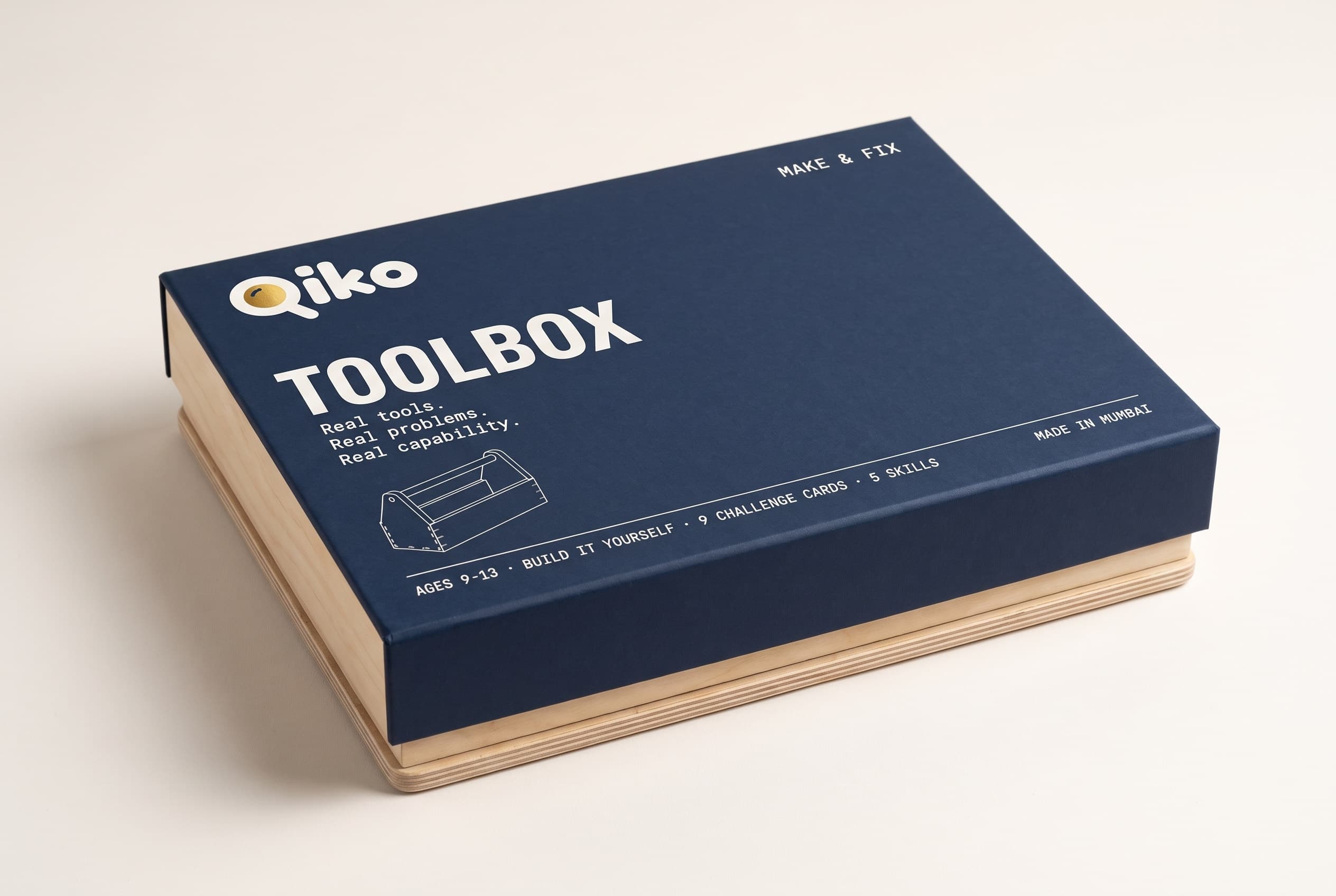
Qiko
Toolbox
- Ages
- 9–13
- Expected price
- ₹699
- With Qiko Tools
- ₹1,399 · saves ₹199
- First pilot
- 6 families
Expected price for the mission on its own. We haven't manufactured any yet, so this is our estimate — you'll know the real number before anyone is asked for anything.
Which one would you want after this?
Optional — it just rides along in the message. Neither exists yet.
Nothing to pay. We'll message you before anything ships.